Gateway Client Settings
Configure client settings
5 minute read
The Gateway panels contains settings determining how the node connects to peer nodes by either acting as a server or client. The tunnels created by these connections are the foundation for the underlay network that enables overlay services like site-to-site VPN and L4 proxy services. Additionally, the Diagnostics page can be of use troubleshooting connectivity issues if layer 4 connectivity has already been confirmed.
The header bar contains settings that apply to both the node’s client and server functionality.

| Field Name | Description |
|---|---|
| Enable UDP |
Firewalls between the client and server must permit UDP on the configured port end to end. See Trustgrid Data Plane for the requirements, including a note on application-aware firewalls. See Tunnels for how the node decides a UDP tunnel is usable. |
| Max Ingress | The maximum total amount of ingress traffic in megabits per second allowed on the node. |
| Max Egress | The maximum total amount of egress traffic in megabits per second allowed on the node. |
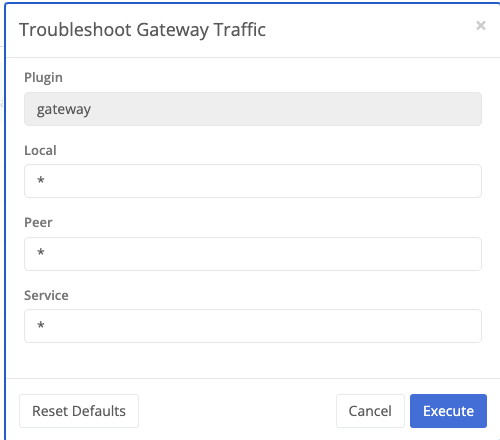
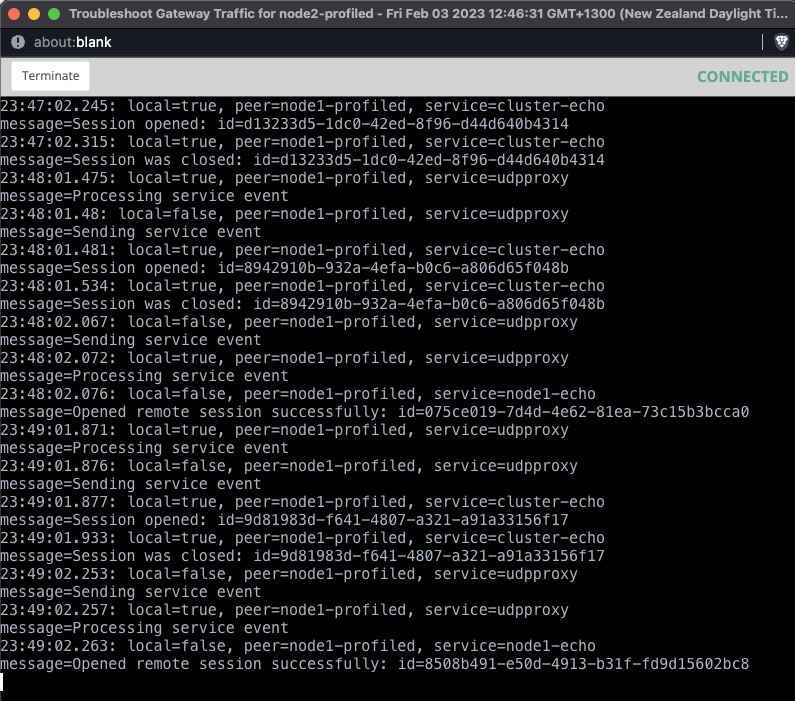
The Troubleshoot Gateway Traffic tool allows you to inspect live diagnostic messages about traffic between this node and its configured peers.

Clicking the “Troubleshoot Gateway Traffic” button will open the below dialog that allows for filtering the output seen in the Troubleshoot Gateway tool by peer, local or service. Selecting what to filter on and clicking “Apply” will update the output seen in the tool. Accepting the default will display all gateway messages.
The output can be useful in troubleshooting why a node and a peer are not connecting.
A gateway client builds two kinds of tunnel to each gateway server it peers with. The portal shows a connection as TLS or TLS/UDP depending on which are in use.
The TLS tunnel is built first and is always present. It runs over TCP to the gateway’s Port, carries traffic whenever a UDP tunnel is not available, and is what a node falls back to if one fails. A node with no usable UDP tunnel is fully functional.
Tunnels negotiate TLS 1.3 where both ends support it, falling back to TLS 1.2. See Security.
The client pings the gateway over the tunnel every 20 seconds. If nothing arrives from the gateway for 120 seconds, six missed pings, the client closes the tunnel. It retries every 10 seconds. A network that silently stops passing traffic therefore takes up to two minutes to detect, where one that resets or refuses the connection is detected at once.
Each connection to a gateway is its own tunnel and times out on its own. This is the same whether the connection uses the default route or an additional gateway path.
Closing the TLS tunnel takes its UDP tunnel with it, since the UDP keys are delivered over the TLS tunnel. Both rebuild together.
A UDP tunnel is built when Enable UDP is set on both the client and the server. It runs to the gateway’s UDP Port and avoids the head-of-line blocking of a TCP tunnel, so it usually performs better on a lossy path. A blocked or failing UDP tunnel costs performance, not connectivity.
UDP tunnel traffic is encrypted with ChaCha20-Poly1305, independently of the TLS version the TLS tunnel negotiated. See UDP Data Plane Encryption.
A UDP tunnel is never built on its own. It depends on the TLS tunnel throughout its life:
The gateway rotates the keys every 15 minutes, over the TLS tunnel, for the life of the tunnel. A rotation keeps the existing source port and does not repeat the test.
Step 4 confirms the path can carry the tunnel before any traffic depends on it:
The test exists for paths crossing an application-aware firewall. Those firewalls pass the first packets of a flow while classifying it, then drop the rest once the traffic is marked unidentified. An untested tunnel looks healthy for that first moment and then silently stops carrying traffic. See UDP Blocked by Layer 7.
Both ends must run n-2.26.0 or later. Against an older peer the node activates a UDP tunnel as soon as it is built, without testing it.
A UDP tunnel that fails its test, or that stops carrying traffic later, is retried on a widening interval:
| Attempt | Delay |
|---|---|
| 1 | 30 seconds |
| 2 | 1 minute |
| 3 | 2 minutes |
| 4 | 5 minutes |
| 5 and later | 10 minutes |
Each delay is varied slightly so a site full of nodes does not retry in lockstep. The interval resets after the tunnel has been healthy for 30 minutes.
A tunnel is treated as flapping after three healthy-to-failed cycles, or five consecutive failures, within an hour. While flapping, the node retries every 10 minutes but reports once a day, and the event states when it will report again. Flapping clears after an hour of health.
A failed UDP tunnel raises a Gateway UDP Tunnel Error. The message distinguishes a tunnel that never established from one that established and then failed, and carries the current retry interval. Establishing a tunnel is logged on the node, so node logs show whether UDP was working before a problem started.
Configure client settings
View aggregate statistics for all tunnels
Configure gateway server settings
Was this page helpful?
Glad to hear it! Please tell us how we can improve.
Sorry to hear that. Please tell us how we can improve.